
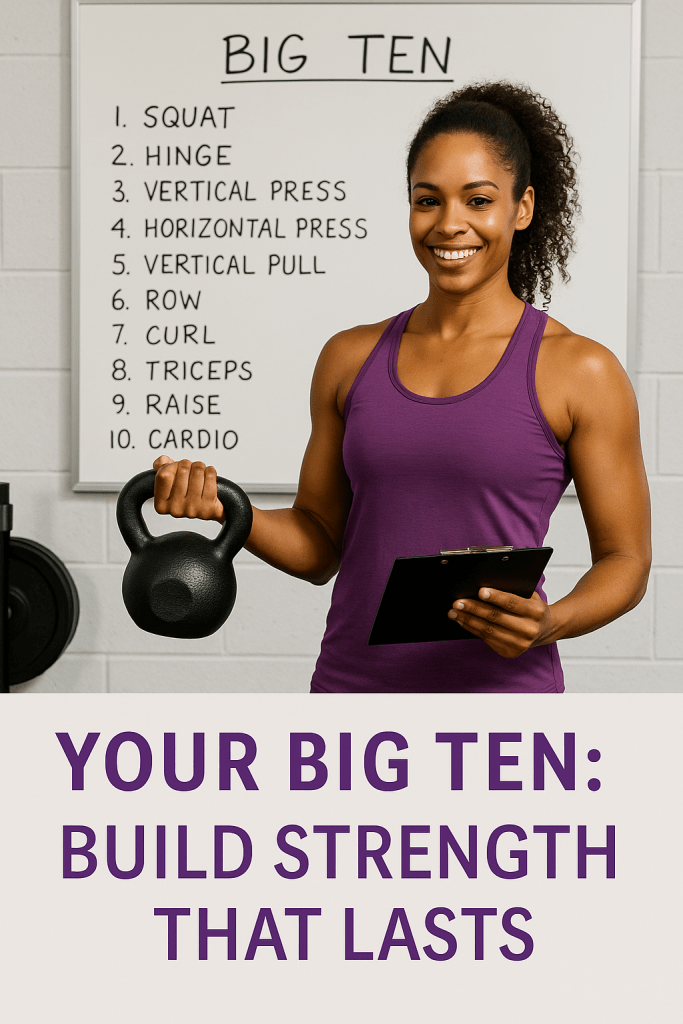
Fitness programming often swings between excess complexity and oversimplified templates. Somewhere in the middle lies a more useful approach: crafting your own list of ten cornerstone exercises that align with your goals, structure, and preferences.
These ten movements form the backbone of your training. They cover essential movement patterns, can be progressed over time, and provide a solid base for strength, mobility, and long-term resilience.
There is no universal “best” ten, but there is a best ten for you.
First, What Makes a Movement Worth Including?
A useful exercise is not simply one that looks impressive or is commonly used. Instead, ask the following:
- Can I perform this pain-free and with control?
- Does it target the intended muscles clearly?
- Can I progressively overload it over time?
- Does it suit my body mechanics?
- Is it appropriate for my training level and current goals?
If the answer to most of these is yes, that movement belongs in your Big Ten.
1. The Hinge
Hip-dominant patterns are foundational for posterior chain development. These include movements like Romanian deadlifts, sumo deadlifts, and back extensions. They’re key for glute and hamstring strength, spinal alignment, and injury prevention.
For those seeking power development, Olympic derivatives like high pulls or hang cleans offer explosive benefits. At-home options like Nordic curls can serve well if equipment is limited. Choose a variation that encourages proper hip loading without excessive strain on the lumbar spine.
2. The Squat
Squatting builds strength through the quads, glutes, and core while enhancing lower body mobility and coordination. Back squats and front squats are excellent, but not always ideal for everyone. Anatomical structure and mobility often determine whether these lifts are suitable.
Elevated-heel squats can improve quad bias and depth. For some, split squats, lunges, or goblet squats may be better tolerated and easier to recover from. All are valid so long as technique and depth are consistent.
3. Vertical Press
Overhead pressing strengthens the deltoids, triceps, and upper back while developing core stability and thoracic mobility.
The barbell overhead press is a classic, but not the only option. Dumbbell presses can be more joint-friendly. The push press uses leg drive for heavier loads and athletic carryover. Handstand push-ups, whether freestanding or supported, are also powerful builders of shoulder and upper body strength. They demand more balance and control, but offer a high reward-to-equipment ratio, especially for bodyweight-focused trainees.
If overhead pressing causes discomfort, seated variations or landmine presses may provide a better mechanical path.
4. Horizontal Press
Horizontal pressing targets the chest, front delts, and triceps. Classic barbell bench presses are effective for maximal strength, but grip width and elbow angle matter a great deal for longevity.
Dumbbell presses increase range of motion and allow unilateral control. Paused close-grip benching shifts emphasis toward the triceps and is often more shoulder-friendly. Dips, when performed with control and appropriate range, are a potent compound option for chest and triceps development. They’re scalable and can be done with bodyweight or added load.
Each variation has trade-offs. The key is finding what loads the tissue without overloading the joints.
5. Vertical Pull
These movements build the lats, biceps, and upper back, while also contributing to scapular control and postural integrity.
Pullups and chin-ups are gold standards. Grip variations can shift emphasis and reduce strain. Pulldowns are a useful regression or alternative, allowing more controlled loading. Straight-arm pulldowns or cable pullovers can isolate the lats more directly, though they’re better used as secondary exercises.
The goal with vertical pulls is to train through a full range, emphasizing scapular depression and active control rather than passive swinging or short ROM.
6. Row
Horizontal pulls develop the rhomboids, traps, rear delts, and lats. They also play a central role in balancing pressing volume and promoting shoulder health.
Barbell rows are effective but demand strict spinal positioning. T-bar rows or chest-supported machine rows allow more focus on muscular contraction with less strain on the lower back. The Yates row is a variation that shifts emphasis slightly higher on the back with a more upright torso.
Inverted rows are a highly accessible bodyweight option. They scale well for beginners, can be made harder with tempo or load, and offer a joint-friendly alternative to heavier rows when recovery is a concern.
7. Curl
Direct biceps work is valuable not just for arm aesthetics, but also for supporting pulling strength and elbow integrity.
EZ-bar curls, dumbbell curls, and hammer curls all have slightly different angles and activation patterns. Reverse curls bring the forearms into the equation, which is useful for grip and wrist health.
Select one variation that allows good tension throughout the range, ideally performed with controlled movement and minimal momentum.
8. Triceps Extension
The triceps play a central role in all pressing and contribute significantly to upper arm size.
Cable overhead extensions provide long-range tension and joint comfort. Pushdowns are easy to load and control. Overhead dumbbell extensions or skull crushers can be effective if shoulder and elbow positions are managed properly.
Choose a version that you can load progressively without flaring the elbows or aggravating connective tissue.
9. Raise (Lateral and Posterior Deltoids)
To round out shoulder development and support joint health, direct isolation of the side and rear delts is important.
Lateral raises with dumbbells or cables train the medial deltoid, while rear delt flys target posterior fibers often underused in compound pressing. Dual-cable lateral raises can provide a more consistent resistance curve and increased tension at the bottom of the lift.
For best results, keep the loads modest and the movement strict. Swinging dumbbells or heaving the weight reduces tension and increases risk.
10. Cardio
Often neglected by strength-focused lifters, dedicated cardio supports heart health, recovery, mitochondrial density, and metabolic flexibility.
You don’t need to run marathons. A few well-planned sessions per week of low-impact cardio like cycling, rowing, or incline walking can improve conditioning and support recovery. For those who enjoy more dynamic forms, hill sprints, swimming, or even shadowboxing can offer variety while building aerobic capacity.
The best cardio is the kind you’ll stick with. Consistency, not intensity, drives the long-term benefit.
Wrapping Up
Your Big Ten is not a list of sacred movements. It’s a living, evolving toolkit built around principles rather than fads.
Each exercise serves a role. Together, they give structure to your training and let you measure progress meaningfully over time. Whether your goal is muscle, movement quality, athleticism, or longevity, these ten movement slots help simplify the programming puzzle.
The challenge isn’t to find perfect exercises. The challenge is to find ones you can master, sustain, and improve upon.

Discover more from Valarie Walton
Subscribe to get the latest posts sent to your email.